


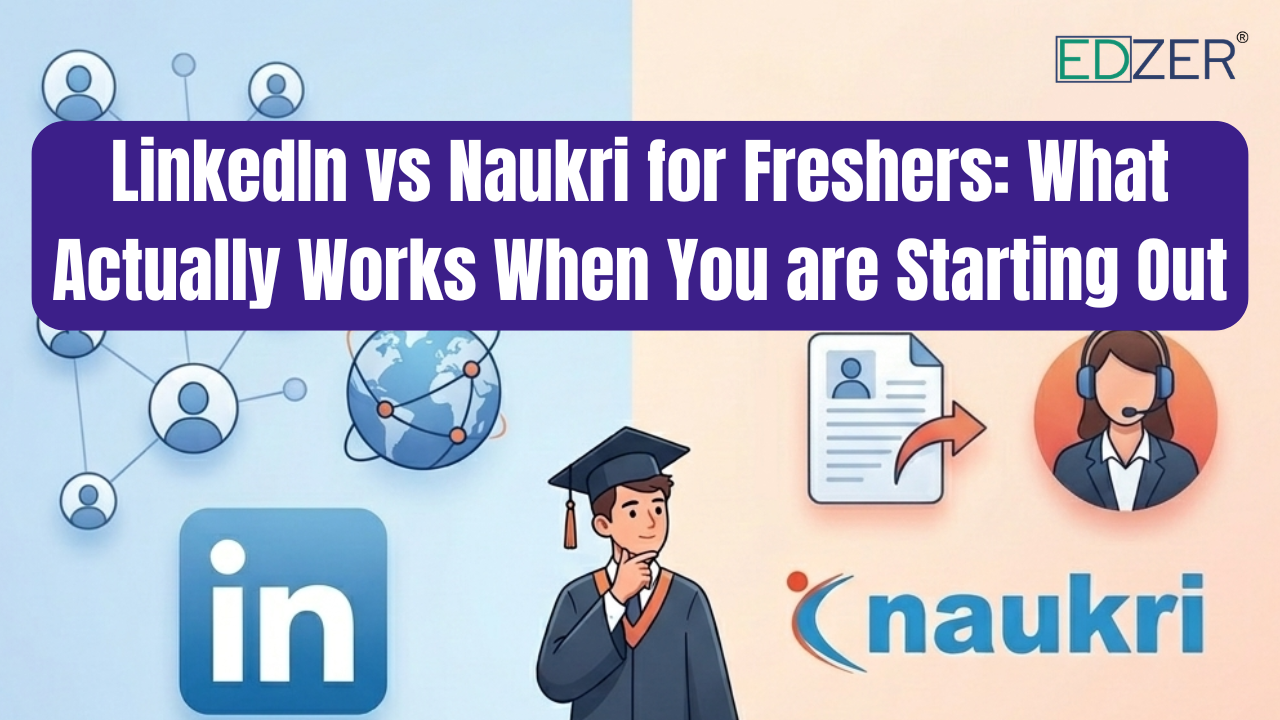
When you are a fresher, job hunting can feel confusing quickly. Everyone has advice, some say “just apply on Naukri,” others insist “LinkedIn is everything.”
The truth? Both matter, but in very different ways. And if you do not understand that difference, you will end up wasting a lot of effort.
Let us break it down in a way that reflects what happens in real job searches.
First, they are built for different things
Naukri is straightforward. It is a job portal. You go there, search for roles, upload your resume, and apply. It is structured, transactional, and very volume-driven.
LinkedIn feels completely different. It’s not just about jobs, it is about people. It is where recruiters browse, where professionals share updates, and where your profile acts like a living resume.
If you treat LinkedIn like Naukri (just applying and logging off), you are missing the point.
How recruiters use these platforms
On Naukri, recruiters usually know what they’re looking for. They filter candidates based on keywords, experience, and location. If your resume matches, you might get a call. If it does not, you probably will not even be seen.
LinkedIn is less rigid. Recruiters often discover candidates while scrolling or searching. Maybe they come across a post you wrote, a project you shared, or just a well-written profile. That is how conversations start there.
So, while Naukri is about fitting into filters, LinkedIn is about standing out.
What tends to work better for freshers
If you are just starting out, Naukri can feel frustrating, but it is still important. You need volume. You should be applying regularly, almost daily. Keeping your profile updated also helps you show up in recruiter searches.
But here is the thing: a lot of freshers stop at that. They apply to 50–100 jobs and wait. That is rarely enough.
LinkedIn is where you can change the game a bit. You do not need to post anything fancy. Even sharing what you are learning, talking about a project, or writing a simple insight can make your profile more visible. Sending a thoughtful message to a recruiter or an employee also goes a long way, much more than a blind application.
The competition looks very different
On Naukri, you are often one among hundreds of applicants for the same role. It is crowded, and unless your resume is perfectly aligned, it is easy to get lost.
LinkedIn has competition too, but it rewards effort differently. If you put in time to build your presence, even a little, you start creating opportunities that are not visible to everyone else.
It is less about “who applied first” and more about “who made an impression.”
So, which one should you focus on?
Honestly, this is not an either-or situation.
Naukri gives you reach. It ensures you are consistently in the pipeline for open roles.
LinkedIn gives you leverage. It helps people notice you beyond your resume.
If you only use Naukri, you are relying on luck and filters.
If you only use LinkedIn, you might miss out on structured opportunities.
The smartest approach is simple:
- Apply consistently on Naukri
- Stay visible and proactive on LinkedIn
Your first job search is not just about getting hired, it is about learning how hiring works.
Naukri helps you enter the process. LinkedIn helps you influence it.
Use both the right way, and you will give yourself a much better shot than most freshers out there.
Best Job Portals for IT Professionals: What Actually Works
If you have ever tried looking for a job in IT, you already know how overwhelming it gets. There are too many platforms, too many listings, and somehow, still not enough responses.
At some point, you start wondering, am I on the wrong platform, or am I doing something wrong?
The truth is, most people are not using job portals incorrectly, they are just expecting the same result from all of them. And that’s where things go off track.
Each platform works differently. Once you understand that, the process becomes a lot less frustrating.
LinkedIn: where opportunities do not always look like “jobs”
LinkedIn does not behave like a traditional job portal, and that is exactly why it works.
You can apply to jobs there, sure. But the real value comes from being visible. Recruiters are not just posting roles, they are actively searching, browsing profiles, and sometimes just noticing people who show up consistently.
For IT professionals, this can be a big advantage. Sharing a project, writing about something you built, or even documenting your learning process can make your profile stand out in ways a resume never will.
A lot of opportunities here do not start with an “Apply” button. They start with a conversation.
Naukri: not exciting, but hard to ignore
Naukri is one of those platforms people complain about, and still use every day.
It is crowded. The same job can have hundreds of applicants. And yes, it can feel like you are sending resumes into a void.
But here is the thing, it still works.
Recruiters rely heavily on Naukri’s database. They search using very specific filters, and if your profile matches, you can get calls without even applying.
The key is to treat it like a system, not a one-time effort. Keep updating your profile, use the right keywords, and apply consistently. It is less about perfection and more about staying active.
Indeed: simple, quick, and surprisingly useful
Indeed does not get talked about as much, but it is one of the easiest platforms to use.
What makes it useful is that it pulls listings from multiple sources, including company career pages. So sometimes, you will find roles here that are not visible on other portals.
It is also great when you do not want to overthink things. You search, you apply, you move on.
For IT roles, especially in smaller companies or lesser-known firms, it can quietly open doors.
Instahyre: fewer jobs, better conversations
Instahyre feels very different from platforms like Naukri.
You do not spend hours applying. Instead, you create a solid profile and wait for companies to reach out. And when they do, the conversations are usually more relevant.
It is particularly useful if you are targeting product-based companies or looking for roles where skills matter more than just years of experience.
That said, it is not very forgiving if your profile is weak. You need to put in effort upfront.
CutShort: a bit unconventional, but worth trying
CutShort does not follow the usual application process. It is more interactive.
You might get matched with roles based on your skills, and then instead of sending a resume and waiting, you are directly in a conversation with a recruiter.
For developers and tech professionals, this can feel more natural. You are not just a CV, you are someone who can explain what you have built and how you think.
It does not have the volume of bigger platforms, but sometimes that is a good thing.
Wellfound (AngelList): if startups are your thing
Not everyone wants to work in a large company. If you are curious about startups, Wellfound is worth your time.
The roles here are often more hands-on, and the hiring process is usually quicker. You also get a clearer idea of what the company is offering, salary, equity, team size, right from the start.
It is not as structured as traditional portals, but that’s part of the appeal.
A quick reality check
No matter which platform you use, one thing stays the same: just applying is not enough anymore.
Especially in IT, your work speaks louder than your resume. A GitHub profile, a few solid projects, or even a well-written explanation of something you have built can make a huge difference.
Most portals will get you visibility. What you show after that is what gets you hired.
So, where should you spend your time?
You do not need to be everywhere. But you do need to be intentional.
Use Naukri or Indeed when you want consistency and volume.
Use LinkedIn when you want people to notice you.
Use platforms like Instahyre or Wellfound when you are aiming for more focused opportunities.
And most importantly, do not rely on just one approach.
Job searching in IT is not just about finding openings, it is about positioning yourself in the right places.
Some platforms help you get seen. Others help you get shortlisted. A few help you start meaningful conversations.
The more you understand how each one works, the less frustrating the process becomes, and the more control you start to feel over it.
Recruiters vs Hiring Managers: The Two Conversations That Decide Your Job
Most job searches follow a pattern, even if it does not feel like it at the time.
You apply somewhere. A few days later, you get a call. It is a standard conversation, your background, your current role, salary expectations, notice period. It is smooth, predictable.
Then comes the next round.
Suddenly, the tone changes. The questions get deeper. You are asked to explain what you have done, why you have done it, and sometimes even defend your choices. It feels less like a screening and more like a real evaluation.
What is happening here is not random. You have just moved from speaking with a recruiter to speaking with a hiring manager.
And if you do not adjust how you show up in these two conversations, you are making things harder for yourself than they need to be.
The first gate: recruiters
Recruiters sit at the front of the hiring process. Their job is to manage volume.
They are dealing with dozens, sometimes hundreds, of applications for a single role. So naturally, they are not going deep into each profile, they are trying to quickly figure out who is worth moving forward.
This is why their questions feel structured. They are checking alignment more than expertise.
Does your experience roughly match the role?
Are your expectations within range?
Do you communicate clearly enough to represent the company well?
That is usually enough for them to decide whether you move ahead.
A common mistake people make here is trying to overprove themselves. They go into long technical explanations or try to cover everything they have ever done.
But that is not what this stage is about.
With recruiters, clarity beats depth. If they can easily understand where you fit, you have done your job.
The real decision point: hiring managers
Once you get past the recruiter, you are no longer being filtered, you are being evaluated.
Hiring managers are much closer to the actual work. They are building teams, managing deadlines, and dealing with real problems. So when they speak to you, they are not just thinking about your resume, they are imagining what it would be like to work with you.
Can you handle the kind of challenges their team faces?
Do you think things through, or just execute instructions?
Will you make their life easier or more complicated?
These are not always asked directly, but they sit behind most of their questions.
That is why these conversations feel different. There is more back-and-forth, more follow-ups, and sometimes even a bit of pressure.
They are not trying to catch you off guard, they are trying to understand how you operate.
Where things usually go wrong
The tricky part is that many candidates treat both conversations the same way. They either stay too surface-level with hiring managers or go unnecessarily deep with recruiters. Neither works well.
If you give short, generic answers to a hiring manager, you come across as someone who has not really thought through their work.
If you overwhelm a recruiter with too much detail, you risk losing their attention altogether.
It is not about changing what you know, it is about adjusting how you present it.
A more useful way to look at it
Instead of thinking in terms of “rounds,” it helps to think in terms of intent.
Recruiters are trying to reduce noise. Hiring managers are trying to reduce risk.
The recruiter wants to be confident that you are worth considering.
The hiring manager wants to be confident that hiring you will not be a mistake.
Once you see it this way, the process feels less confusing.
How to approach it without overthinking
You do not need a completely different personality for each stage. Just a shift in emphasis.
When you are speaking to a recruiter, focus on making things easy to understand. Connect your experience to the role clearly. Keep things structured.
When you are speaking to a hiring manager, slow down and go deeper. Walk them through your thinking. Talk about decisions, not just outcomes.
And if you do not know something, it is fine to say so, if you show how you would approach figuring it out.
The part most people overlook
It is easy to assume that the hiring manager is the only one who really matters. But both roles carry weight.
A recruiter can advocate for you, or quietly drop your profile. A hiring manager can be impressed, or unconvinced. You need both to be on your side.
Job interviews are not just about having the right answers. They are about understanding the conversation you are in.
Once you start recognizing the difference between a recruiter’s lens and a hiring manager’s lens, things begin to click. You stop trying to say everything at once and start saying what matters. And that shift, more than anything else, is what makes the process feel a little less unpredictable.