


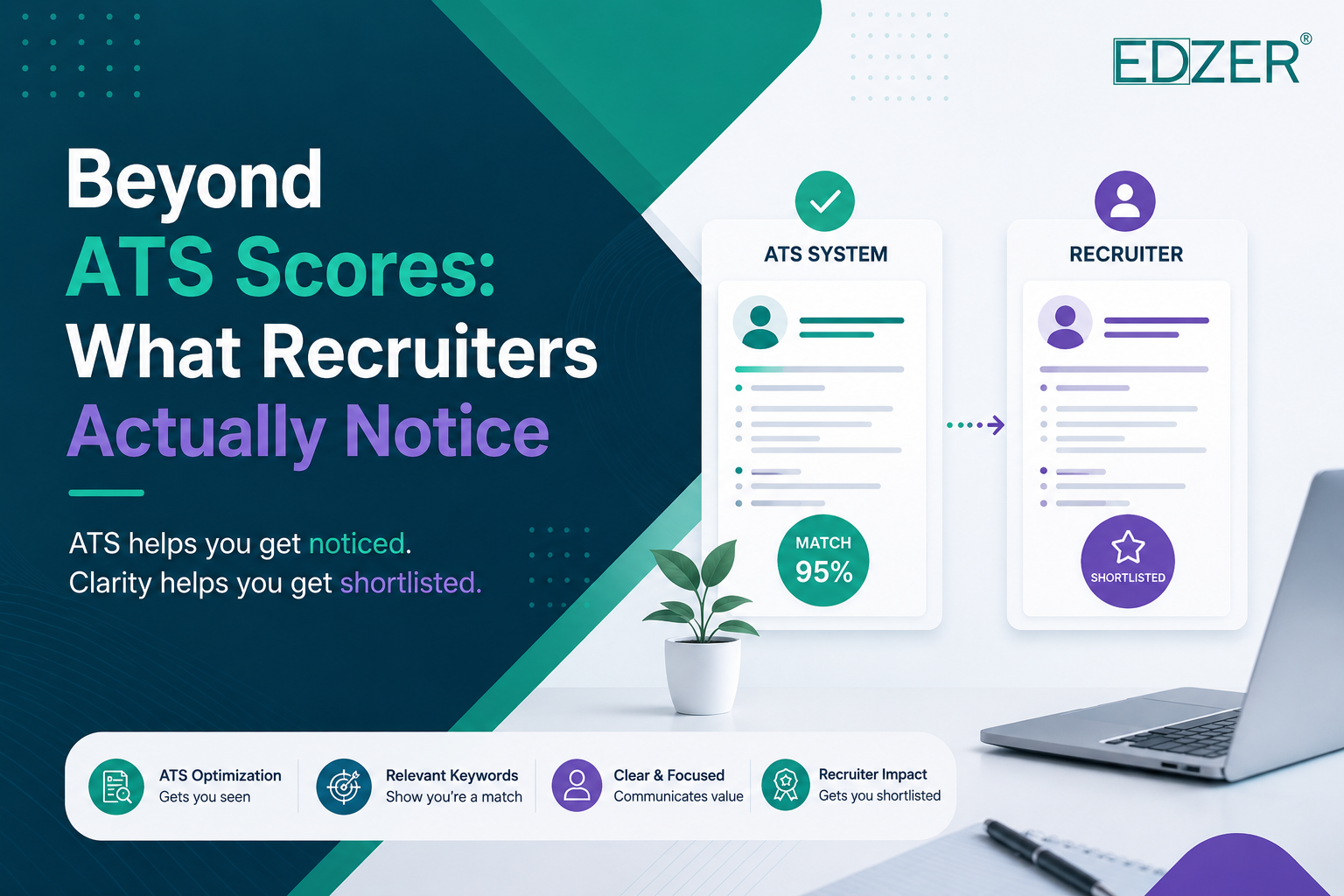
Why Your ATS Score Doesn’t Guarantee Interviews : A lot of job seekers today are becoming increasingly focused on one thing: their ATS score. Before applying for jobs, many candidates upload their resume into online ATS checkers, wait for the results, and feel confident if the score comes back high. Somewhere along the way, people started believing that a strong ATS score automatically means better chances of getting interviews. But then something frustrating happens. The resume scores 90 or even 95 out of 100, applications are sent out consistently, and still, the interview calls do not come.
That is usually when candidates start questioning everything, whether companies are actually hiring, whether the system is unfair, or whether their resume is somehow still not good enough.
The reality is much simpler. An ATS score can help your resume get through a system, but it does not guarantee that a recruiter will shortlist you after reading it. That difference matters more than most people realize. Most ATS tools are designed to check technical compatibility.
They scan resumes for formatting, keywords, section organization, and alignment with job descriptions. In simple terms, they mainly check whether your resume can be read properly by automated systems. And yes, that part is important.
If your resume has poor formatting, missing keywords, or overly complicated designs, there is a chance it may not get scanned correctly. So ATS optimization absolutely helps. But many candidates make the mistake of treating it as the final goal instead of just the first step. Because hiring decisions are still made by people. A recruiter is not sitting there thinking about whether your resume scored 94 or 97 on an ATS tool.
They are trying to understand whether your experience, skills, and background actually align with the role. That evaluation goes beyond keywords. Two resumes can have similar ATS scores but leave completely different impressions. One may feel focused and clear, while the other feels generic even though it is technically optimized. This is where many candidates unknowingly struggle.
In an attempt to improve ATS scores, resumes often become overloaded with keywords, tools, certifications, and skill names. The resume may pass a system, but once a recruiter reads it, it can start feeling repetitive or unnatural. Sometimes it feels more written for software than for an actual person. Another thing candidates often misunderstand is how ATS systems are actually used in hiring.
Companies today use ATS platforms as part of their recruitment process to manage applications and streamline hiring. However, the extent of filtering and automation can vary depending on the company, hiring volume, and recruitment workflow.
Regardless of the system being used, resumes are still reviewed by recruiters who evaluate whether the candidate’s experience and background genuinely fit the role.
That is why a resume needs to do more than just perform well technically. It also needs to communicate value clearly to a real person. There is also the issue of relevance. A resume can be perfectly optimized and still fail to connect with the role itself.
Many candidates use the same resume everywhere, assuming a high ATS score will be enough. But recruiters can usually tell when an application feels too broad or generic. A resume should clearly show how your experience and skills relate to the role you are applying for instead of trying to match every possible keyword.
That clarity matters far more than people think. This becomes even more important in 2026 because hiring has become more selective across industries. Companies are not just looking for candidates who match keywords word for word.
They are looking for communication, relevance, adaptability, and real problem solving ability. Those things are difficult for ATS tools to measure accurately. There is also a psychological side to this that people rarely talk about.
A high ATS score can create a false sense of confidence. Candidates assume their resume is already perfect, so they stop improving other parts of the job search process. They continue mass applying without tailoring applications, improving interview skills, networking, or understanding what companies are actually looking for. But your resume is only one part of getting hired.
A good resume does not just pass a system. It creates enough interest for someone to continue the conversation. That is why the strongest resumes usually balance optimization with clarity.
They include relevant keywords naturally while still sounding human and focused. ATS optimization should absolutely matter, but it should be treated as the foundation, not the finish line. Because ultimately, software does not hire people.
People do. And at the end of the day, a high ATS score may improve your chances of being seen, but being seen is only the beginning. What matters after that is how clearly your resume communicates value beyond keywords. And that is something no automated score can fully measure.
Get your free resume review from one of the most trusted resume writing company now :https://edzer.org/